
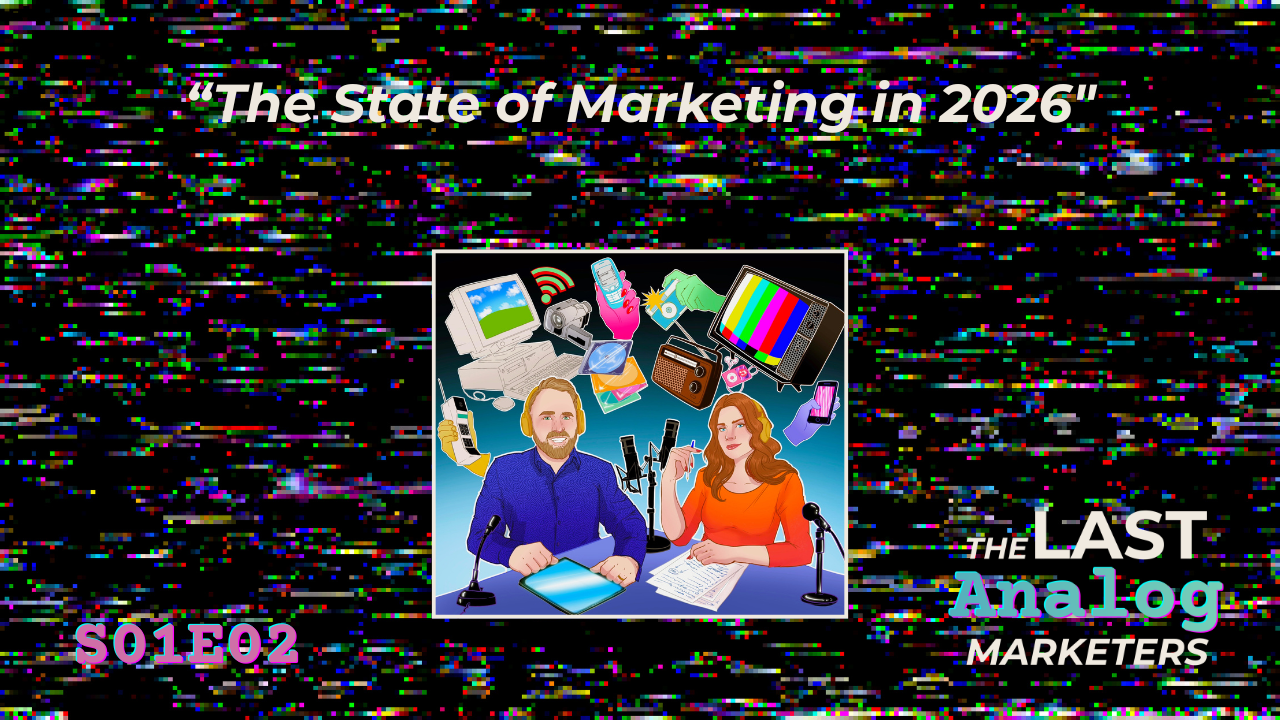
Announcer (00:02)
And now, you’re listening to the Live Analog Marketers Podcast. For marketers who lived through the transition to digital and the newcomers who inherited the results. Using the past as a lens to understand the present and navigate the future with intention. With your hosts, Aaron Peterson and Jamie Jones.
Jamie Jones (00:30)
Again, welcome to the Last Analog Marketers Podcast. I’m Jamie Jones.
Aaron Peterson (00:35)
And I’m Aaron Peterson. Today we want to start to cover the current state of marketing. We’re not doing any time traveling. We’re just talking about what’s happening right now. We’re not gonna get into nostalgia hour, we’re not gonna get into futurism forecasts. We’re gonna save that content for another day. Very close coming up behind this because we do wanna get into how we got to where we are and where we think we’re heading. But for right now, we’re gonna start with where we’re at right now in the marketing industry.
Jamie Jones (01:06)
Exactly. We have some perspective on what marketing is doing in 2026. I don’t know if we have all the answers, but we’re definitely very familiar with the clicks, the chaos, and the coffee-fueled spreadsheets, which has fully been my life the last few years. Let’s dive into the themes that we want to cover today. I think we have three present themes that we’ve kind of bucketed stuff into. I’m sure we’re gonna miss some stuff, but I’m really excited to talk about these three things because they’re really near and dear to both of our hearts and the experiences that we’ve had in the last couple of years. Mine is the last couple of years of my career at Kantar, which is data-driven marketing. Marketing today is insanely data-driven. And I will tell you, at first I was super excited about that because there was a point in time where we would create something and ask the sales team or the client management team to send it on our behalf. And we would just assume it eventually got somewhere and we were eventually reaching the end user in B2B marketing. But today, all of our creative, all of our different channel marketing that we do is scored. We have view rates, we have heat maps, we have scroll depth, we have cohort LTV – everything comes with a measurement. And I think 10 years ago I would have been excited about that. And now sometimes it feels really overwhelming.
Aaron Peterson (02:33)
I mean it also feels really restrictive. As someone who has planned and bought media, I feel like we’re also professional analysts now. Which, again, not to say that I don’t love data. I do. And I do think data is important in driving decisions largely, but it does feel like the Creative Brief now basically starts with “What’s the SQL query?” instead of, “What’s the big idea?” And it just feels…disjointed.
Jamie Jones (03:01)
When was the last time you heard someone just say, “Let’s have a big idea and make it work?” It’s always, “What are we gonna get out of this? What’s the ROI?” It’s all about attribution models and multi-touch and increment incrementality tests. It’s a mouthful, truthfully, because I think it makes marketing less creative. It makes us just analysts, as you were talking about. I can’t remember a campaign I’ve launched in the last few years that didn’t come with a fully built-out spreadsheet of a tracking plan. The tracking plan was the most important piece, not the creative part of it.
Aaron Peterson (03:39)
Weabsolutely. And on the ad buying side, it just means constant experiments. A/B tests, holdouts, geographic lift tests, brand lift tests. I mean, the creative that really looked great in a brainstorm session gets lost, it dies in the data because it can look like a really great idea and even it could be that kind of idea that has a great risk to it, but the data says, “Not worth it.” And so it gets lost.
Jamie Jones (04:11)
And being from market research where both you and I spent a lot of time, it only feeds that even further, right? Because segmentation becomes micro segmentation. And we’re thinking about different messages or different platforms across zip codes or looking at people who have previously disliked our animated gifts. There was so much analysis paralysis that you really lost the creative totally in the process.
Aaron Peterson (04:39)
Yeah, I think that you struck it right there, which is the data gives you confidence, but it’s also paralysis. You know, it feels like clients and internal stakeholders that you work with, they want statistical significance yesterday related to the campaign that you’re planning today that hasn’t even launched yet. And so it does. It just feels like a lot of those marketing things that we could get excited about have been contained or held back in a lot of ways.
Jamie Jones (05:10)
And the interesting thing about being part of the marketing team in a B2B environment is that you are seeing what your clients, your oftentimes B2C clients are doing and also kind of understanding that B2B is a different beast. But the people who are managing those B2B B2C clients kind of want you to do the same thing internally, even though you recognize it doesn’t always work. And so I feel like there was data-driven storytelling that we would tell our clients to do. And then we would try to replicate it as a B2B company. And it just didn’t really quite work. But overall, I think the common theme that we saw, whether it was for our clients or for our own internal campaigns, was just this real hesitance that started to emerge over the last five or 10 years to try things unless you had the data to prove the success.
And it felt really constricting. We talked on our last episode about how being creative is one of the things that brought us to this profession. And the analytics behind data-driven marketing sort of put you in handcuffs around that a little bit. Sometimes it really does feel like we have the cart before the horse, as they say. Things are going a little bit backwards, and I’m not sure how to get out of that. But I know that I really miss when we could just be creative and we could just be fun. And our leaders trusted us. I think that was the big switch I’ve really seen as data has become such a part of marketing, is that our leaders told us to fail fast. But then when we did, they were really pissed about it. And there really wasn’t a lot of tolerance for failure.
So I think that, especially in the last couple of years when I was super-focused on commercial marketing and trying to tie attribution at the B2B level, there’d be so many touchpoints and so many parts of an organization would talk to a prospect or a customer. And how could you really say if a webinar or a face-to-face event or an email or something was the piece that really brought that person to the table? And instead of being happy that the revenue was there or the client was happy, there were a lot of people wanting credit or people wanting to take it upon themselves to say, “I’m the reason that this happened.” And so that kind of fighting with your sales team or fighting with your client management team is a really challenging part of marketing. If you’re in marketing, I think you kind of know that. And I used to always go into meetings saying, “Hey, this is, it’s a little bit of an art and a science. I have data, I’m going to show you some things. I’m really excited about the attribution that we can connect, but at the end of the day, this is qualitative plus quantitative.” And unless you have an organization that really believes in that, I think marketing’s kind of set up for failure.
Aaron Peterson (08:08)
I agree, and I think also to add on to that, part of the challenge is that marketing teams are focused on creating those opportunities for sales, for client service relationships. But what’s interesting is that, to your point, where we are not often given credit. We have to fight for credit with these teams, it’s especially hard in those B2B environments because a lot of what you’re trying to do is prove some sort of marketing impact or attribution related to existing clients, right? It’s not something you often have, especially in those certain types of businesses, service oriented businesses – most of your existing business and your growth comes from your existing clients base and then you add on small amounts of prospects over time. And in those environments, marketing is especially challenged, right? Because if you’re in an environment where you’re just getting in prospects all the time, it is a lot easier to show that marketing attribution.
Jamie Jones (09:10)
Totally.
Aaron Peterson (09:11)
But outside of that, it does get way more challenging. And I like to think of myself as a very data-driven person, in general. And I wouldn’t argue necessarily with the idea that a large portion of the decision making that needs to happen should be driven by data within those groups. But I think that that being said, it does create paralysis because, instead of, to your point, looking at overall success, coming together to say, “What are all the various ways in which sales, client service, product, marketing, IT tech support, all those different elements, how can we all come together and do what we do in our function to support the overall growth of the client? And how do we all contribute to that?” Instead it has really largely become, like you said, these siloed little areas because we’re so focused on all of that data. And what that ultimately does is it also hinders us from taking any sort of risks.
And I think that’s especially a big challenge for B2B marketing, because in B2B marketing, in more cases of B2B marketing than B2C marketing, you’re typically advertising or marketing to multiple stakeholders in B2B, right? You’re not, if you’re selling a software product or service, for instance, you’re not just selling to that end user who needs to use the tool, but you’re selling to the head of IT. To someone in finance, maybe somebody on the executive team. And so you’re really marketing to a plethora of stakeholders across a variety of channels because you need to be able to hit each of those stakeholders at every stage of the funnel that they’re in. So you, in that scenario, end up with this large grid of activities and content and programs that you need to do. And with the focus on data, it really kind of puts you in this box, right, as a marketer, where you really feel like, “Okay, there’s only these things I can do, and they have to have this result to them, or else I’m failing.” And so I do think that there’s…I do wish that we would get back to a little bit of less focus on the data, as much as it is really important. But I do think that we need to find and strike a balance between data and risk and data and opportunity and saying, “How do we have the courage to maybe take a risk where the data might have told us not to do it?” I think especially when you think about creative, if you run a creative idea through testing, you could run it through there and it could get killed in that testing.
Jamie Jones (11:44)
No, I completely agree, and it’s funny, we hadn’t chatted about this analogy, but I thought about it as you were as you were talking that – Sales is kind of like the striker on the soccer team, right? They get the goal and everyone celebrates them. But, getting that ball up to the opportunity to actually score comes through many different facets of the team. And truly, the best teams are the ones who really all contribute and play as a team together. And I think in B2B, we’ve really lost that.
I had that conversation so many times with the sales team where I’d say, “I don’t get credit for this sale. I’m not taking anything from your compensation. I’m just merely trying to prove that the activities that we’re putting on that take a lot of time, take a lot of creative energy, are part of my day to day, are valuable. And please let me recognize that within the technology system so that we can continue to prove to senior leadership that these are things we should have.”
And it always felt like we were trying to take something away from them instead of working with them. And I think you were talking about selling into this team environment, right? That in B2B, that there’s procurement, there’s the individual buyer, their senior leader, all these different stakeholders. And it kind of is a team you have to convince.
But we approach it as an individual instead of like bringing a team against a team. We sort of don’t do that. And we fight against each other internally. So I think there’s definitely some things to be fixed. I hope we’ll get a guest eventually on who can tell us that they’re doing it really well and we can try to learn some things from that because I’m certainly bringing stories of what not to do. But I gotta imagine that people are doing it right. So we’ll try to find one of those people.
Aaron Peterson (13:30)
Yeah, I agree. I agree. Although that is a good segue into point two, so…
Jamie Jones (13:34)
Yeah. Very good segue. So point two of where marketing is today in 2026 is going to be no surprise to anyone because it is everybody’s existence, whether you’re in marketing or not, and that is attention. How do we create attention? How do we buy attention? And how do we hold attention?
Aaron Peterson (13:55)
Yeah, attention is THE hot commodity, right? I mean, not only has it been a buzzword for a while now, but it feels like anytime there’s an industry event lately and there’s the recap, you know the couple of things you’re gonna hear about. Obviously one of them’s gonna be AI and one of them’s gonna be attention. They’re definitely gonna be in that recap somewhere. There’s more content than ever, and less uninterrupted attention. So that’s kind of marketing’s reality now. We’re in this very weird state.
Jamie Jones (14:29)
Part of why you and I are here today and part of the goals we set on our last first initial podcast was talking about infotainment, right? There’s so much, but how do you create something that’s valuable? And I think we’re really pushing brands in all capacities to be experienced designers. It’s not enough anymore to just interrupt someone’s time, you need to be able to reward the time that they spend with you, even if it’s for a short little bit or for a really long time. People want to feel like it was worth their time to pay attention to something.
Aaron Peterson (15:03)
Yeah, absolutely. I mean, we’re seeing a lot more of the short-form hooks and reels, modular creative, across those different layered campaigns, and they reward that deeper engagement. And so it’s thinking about it like a quick snack for a scroll, but a longer snack for the subscribers. And so you can kind of hit both worlds. and you can also lure people from one side into the other, right? Go from being a snacking scroller to being a subscriber if your content and how you put it out there is, like you said, engaging and rewarding in a way that makes it that they want to follow and be further engaged.
Jamie Jones (15:42)
Exactly. And I think it’s kind of a test. Going back to that “fail fast,” right? We know that sometimes people really are engaged with a brand in one context, in one channel, and then totally behave differently somewhere else. How I behave in my search bar or in my AI chat app or with a podcast or with a streaming app. I know personally, a focus group of one over here, I do different things and times that by millions of different people. So brands are certainly challenged to figure out the right way to create and keep attention. And one creative isn’t going to do the trick. They’re gonna have to try a lot of things and figure out what hits and what doesn’t. And I think that really goes back to the idea of failing and trying and marketing needing to be able to be a mechanism where something can fall flat and it’s okay. There can’t be this deep fear that, if it doesn’t work, then somehow our jobs are on the line or we’re not going to be successful. I think one success and a bunch of failures actually produces some really great brand content and really great brand feelings from people. And that’s really gotten lost as we’re just searching for attention constantly and then trying to measure that attention constantly.
Aaron Peterson (17:10)
No, I totally agree. And I think for me, what I think about is, and again, we all have our own behaviors and quirks – which is part of why you and I both also find marketing and market research very fascinating because it’s really interesting to understand people and their behaviors – but, I think about from my personal, again, study of one, but I look at the activities that I do on my devices based off of what the activity is. For instance, if I’m shopping on Amazon or another retailer like that, I’m gonna do that from my mobile phone. I might scroll on the couch or wherever I’m at. But if I’m going to go make a big purchase, like I need to purchase a new fridge, I’m not, for whatever reason in my brain, I cannot get over the idea of making that purchase of a fridge from my mobile phone. I have to go to my laptop or computer to do something like that because it feels like, well I need, I don’t know, something more about it. But it just goes to show you that as marketers, we need to think about that and calibrate the bids and the creative and all of that by context, right? Because people and audiences have all of those really different behaviors. High intent channels cost a lot more, but the conversion quality is often higher. So it’s almost do you do that or do you go to the low intent channels that need that smarter creative and where you’re gonna do retargeting to work with them? It’s a balance and some marketers focus on one or the other, some of them do a mix of it. But I think that that’s probably one of the things we really need to focus on going forward and right now, is just really making sure that we’re managing that element of context behind how we’re reaching those audiences that we’re trying to get attention from.
Jamie Jones (19:01)
Yeah. And I think as we talk about our personal experience, right? I obviously have a lot of engagement with ads and social media, especially Instagram. And do find that either I’m purchasing or on the brink of purchasing something because it is so easy and right there and feels like something I need. And I’ve been retargeted by that ad or retargeted something from it so many times. On the flip side, in the B2B capacity, I would have LinkedIn try to come and say, “Look how successful your ads are, look how successful your promoted content is, because these brands are engaging with it and these brands spend money.” And I kind of would dig under the hood a little bit with the people who were running those campaigns. And I’m like, okay, well, tell me how you know this. And really, when you kind of dug under, what you saw was that the people who spent a lot of money with the company tended to engage with the content. But it was the same challenge we had as an internal marketing team, right? Did they spend money because they saw those ads or that promoted content, or were they already doing stuff and so therefore just showed interest in the things that were of a brand that they were familiar with? So it was really hard to kind of understand whether that investment was valuable or not valuable. And everybody is being challenged to kind of show that economics and it was really hard to do.
Aaron Peterson (20:28)
Yeah, I think that it also made marketers struggle because we were put in a place where our hands were tied. We needed to be able to deliver, but we also were not being necessarily put in a in a position to to be successful for that.
Jamie Jones (20:50)
Yeah. Yeah. I mean, success nutriments were probably the nightmares that kept me up at night, right? Because it does, it just sort of felt like there was such a lack of control of knowing what was gonna lead to dwell time or conversion flows or click throughs or impressions. And there was so much pressure put on success, and high depth cost-per-dollar, cost-per-click. And it was just really difficult to actually showcase that. So yeah, it definitely kept me up many nights.
Aaron Peterson (21:29)
Well, and I think a lot of marketers need to just have that more practical move, right? Which, it’s not sexy, but they need to prioritize the channels by their attention yield. They need to design layered funnels and invest in those creatives that really earn time rather than demand it from the audience. Because like we’ve seen, it’s just not working the other way. You have to be able to show the value, show the reward in order to get the attention.
And I think that’s especially important in B2B marketing because there are often a number of those stakeholders involved, like we were talking about earlier. So you really can’t have that one size fits all approach with these campaigns or with the way that you try to message to these to these people because what you say to a CFO is obviously not necessarily gonna resonate with a CIO or CTO or your stakeholder if that stakeholder is a client in a brand space or a business itself.
Jamie Jones (22:28)
And especially when you have a product line that’s multifaceted, right? This is not just, “Does one product hit a certain audience in a certain channel?” and we do or do or don’t do that again. It’s 12 products at the same time, and all those different channels, and all those different stakeholders. And so the matrix and the web just would get bigger and bigger and bigger. And it often just felt like putting fingers in a leaky bucket, right? You’re like, “Well, this one’s not doing good. We’re gonna move it over here.“And you never could quite find success because there was always something kind of red. The red light was going off on something, even when there were a couple of green lights going on.
So we don’t have the answers. We know that attention, for B2B and B2C, is a real challenge in 2026. I have seen a lot of reports of very big brands, B to CPG brands moving a lot of money into influencers, which to think that that’s the place we live in today, I’m certainly not the expert, but probably we should have a whole episode about influencer marketing because I think that would be really, really interesting. But attention is hard to get and it’s hard to keep, but it is probably the biggest buzzword of our industry today.
So we’ll put a pin in that and maybe come back with some thoughts on how to do it better on another episode, but we’ll move on at this point to the third point. And it actually has to kind of do, I think it has to do with internal structure, and kind of tying the first two points together in a really practical way.
Aaron Peterson (24:03)
Yeah, I agree. And so our last point here is that marketing today really can’t be siloed. And what we mean by that is brand, content and creative, comms, digital, demand gen, media, research analytics, all the elements that go into it, they all have to operate like one team. Otherwise that measurement and the attention wins that we’ve put together, they vanish, right? Like, they just go away because it only works when we work together as a functional team. And what you are seeing a lot more often is, especially within bigger companies, which you and I have both been a part of, these type of marketing organizations where things really do get siloed and you get in a position where it’s like, okay, here’s a growth marketing team that has like demand gen and events, and then you’ve got brand and comms over here doing stuff completely separate, and they don’t necessarily meet with each other. So it can be a big problem.
Jamie Jones (24:57)
Yeah, no. And they all have different goals and sometimes have different bosses and sometimes have different revenue lines. So it can be even worse than just not talking to each other. But the funny part is that they’ll have all these different technologies, have all these different campaigns, have all these different vendors, and they’ll just call it “omnichannel.” We’re doing omnichannel, like that it’s, okay. That it’s a disarray and it’s totally disorganized and no one has the same goals. But in reality, you and I both know personally that that creates an immense amount of friction and KPIs that don’t match each other and in general a lot of creative inconsistency.
Aaron Peterson (25:41)
Well, yeah. For example, if we had research that told us that audience A prefers a problem first messaging, but then the media buy shows the best placement is in mid-funnel. And then the creative team is doing their way, but way their work, but they decide to make product focus spots because that’s what their research told them or where they were focused. And none of that got coordinated across those different developments. So of course the campaign and the performance of everything that the team is doing tanks.
Jamie Jones (26:12)
Yeah. And I think it kind of goes back to what we were talking about earlier in the conversation, approaching it as a team, right? You’re selling into an organization that is protecting their budget as a team, if nothing else, right? They’re all in agreement that we can’t spend until we all agree. But we don’t approach them with a real team effort and a lot of operational rigor, briefs are not shared. There really is an essential data point. There are never weekly sinks. It’s sort of like, “We have this problem and come back to us once you’ve solved it.” And I have seen very little usage of shared metrics. It’s really not glamorous stuff. It’s certainly not the creative part of marketing, but I do think the times when I would call them like “tiger teams,” the times when it was multiple people from different parts of the organization coming together for one goal…that’s when things seem to work the best and be the most functional.
Aaron Peterson (27:11)
Yeah, and I think to add on to that, though, but part of what creates even additional chaos is the governance around those metrics, like who owns it and who signs off on the approval of the creative test and who agrees on the brand lift. I mean, because what we end up seeing is that that ambiguity means that nobody optimizes what they’re doing and nobody takes responsibility for optimizing the collective.
Jamie Jones (27:37)
Well, and the funny thing was, is…we built a bunch of really expensive – built or bought a bunch of really expensive – technology on top of a system that was already misaligned and broken. So let’s just throw a million dollars at Salesforce because certainly that will solve our problems. But the tech stack was only as good as the processes that were already in place and the people that were put in charge of the governance of it, as you said. And I think what it really ended up being was just a lot of expensive chaos. We had cheap chaos, and then we had expensive chaos. And in general, too many cooks in the kitchen. I mean, I remember feeling like I was looking for a CIO to come in and say that somebody needs to be doing a better job of managing the funnel. And I seem to be the only person at a VP level – which is high, but not that high, right? – I seem to be the only one screaming from the rooftops, “Hey, we are not using this technology properly. We are all not on the same page.”
And why is the marketing person saying this? But we were laughing before the call. It kind of comes down to marketing to be that person sometimes. And so, I really appreciated the times when we worked on projects where it was, as I said, a “tiger team” brought together. There was a pipeline that was very aligned. There was like this collective unit, and no one was out for themselves. Everyone was trying to build it and move it together in the right direction, but that was definitely the exception, not the rule.
Aaron Peterson (29:09)
Yeah, exactly. But in that scenario, success looks like reduced friction in the handoffs, having faster test cycles, having marketing decisions, and also broader decisions in the organization, right? All align to that one source of truth. And so the KPIs that we’d look at – time to decision, campaign cycle time, lift in cross channel conversion – all of those things get impacted and improved. If we’re able to be better connected and better aligned across not only the marketing team but the broader organization as well.
Jamie Jones (29:48)
Yeah, I think it’s not a sexy thing to talk about, but integration and collaboration as in internal functions, I mean, really is the place that we feel marketing is in 2026 and one of the points of either success or failure, depending on how your organization is attacking it.
So I think those cover our three topics for today. 2026 ss an intense time for marketing. We are under the gun for trying to improve KPIs and measurement at every turn. I think there’s a lot of opportunity to bring the creative aspect back into the fold, but we’ll see if that happens or not. Obviously, all organizations, including the marketing function within them, are vying for attention. That is incredibly difficult to gain and even harder to keep. But there are infinite amounts of channels available to use to try to gather, garner and gather those. and I think that there will continue to be a lot of test-and-fail and trying to figure out where people are sticking with brands. And last but not least, just bringing together that operational glue and working more as a team, more as a “tiger team” within the organization, I think will allow marketing to be stronger. Too often marketing is left to fail, succeed and fail all alone. And I think when brought into the fold within other parts of the group and collective, there’s a lot more opportunity, you know, for success.
Aaron Peterson (31:31)
I totally agree. And I think it is a tough landscape out there right now for sure. There’s just like we said, there’s so much going on, there’s so much attention to be needed and had. There’s so many products and services out there to put in front of people. But I think if we as marketers stay positive and we focus on those three areas – measuring smart, designing for attention and getting people to actually talk to each other within their own marketing teams, within their broader organizations – rather than burning and wasting money on things that don’t work. When they can get out better quality content, products, marketing campaigns that actually have impact on driving the needle in whatever way they’re trying to do.
Jamie Jones (32:15)
Yeah, I have been sidetracked by someone’s shiny new idea, maybe more times than I’d like to admit. So I agree. Lots of opportunity and reasons to be hopeful. All right, Aaron, that’s the last of the content we prepared for today. As we mentioned earlier, a lot more to come. But as we wrap up this episode of The Last Analog Marketers, do you wanna lead us out with our One Last Thing?
Aaron Peterson (32:43)
Sure. And I mean I think you kind of talked or at least touched on it briefly earlier, which is one of the things that you and I have noticed is this sort of shift in the dynamic of how marketing fits within the organization. And one of the things that we often do feel like is that we have to play the role of the adult within the business organization, right? And what I mean by that is that, and to your point, when things go successfully, everyone in the organization wants to say they were involved in it. The sales people are like, “Yeah, I activated that campaign.” The client service people, “Yeah, I got my client to give a quote.” Everybody wants to be involved. When it goes poorly, they’re nowhere to be found. And instead there’s a lot of finger pointing. There’s a lot of no and again, nobody wants to get in trouble, as it were. And so rather than address the problem head on, you end up in these scenarios where people are somewhat in their silos, their fiefdoms. They try to be protective. They point the finger in other directions. Nobody wants to take the blame. And marketing often we default to being the ones that just take the blame
And we will shrug it off and then we will not only do that, but we will then on top of that be in a position where we will have to come up with the solution, right? We’ll have to come back and say, okay, look, this thing didn’t work. Let’s come back and let’s figure out a way to make it work. And so we really do, it does feel like we often have to be the adult in the room that comes in and says, “Okay, let’s not point fingers. Let’s not focus on what went wrong and who did what. Let’s just focus on what do we do now and how do we move forward to be successful.” And so it’s an interesting place for us to be in. In a way, it’s great. We do get to have some guidance and impact on how to handle situations. But on the other side, it also does put us in a very precarious position, right? Because especially in an age right now where roles are very scrutinized and success metrics are so important as we talked about in this call, if you are not successful in marketing nowadays it really is a risk of whether or not you’re going to keep your job and whether or not you may potentially be let go.
Jamie Jones (35:06)
Yeah, I think it goes back to what we talked about on the first episode.Marketing seemed like a fun and safe place within the organization to be. And I’m not sure it is anymore either. But I liked the idea of whenever the house gets burned down, marketing’s the first one who kind of gets the shovels and the concrete ready and we start rebuilding. And I think that was fun and exciting and empowering.
But maybe for people who’ve been in the business a really long time, we feel exhausted by that. We’re kind of sick of always having to rebuild the house once it gets burned down and we’re looking for a more collaborative business environment where things don’t get burned down and the fire only goes one level and we kind of stop it there and keep…
Aaron Peterson (35:51)
…with hurricane hurricane proof windows and things like that. And so we don’t have to keep rebuilding the foundation and all of those elements, right? And that comes back to that collaboration we were talking about at the end of this, right? If the teams actually work together and collaborate more efficiently, we’re gonna have less of those failures. We’re gonna have less of the house getting knocked down.
Jamie Jones (36:13)
Yeah, absolutely. Well, that’s all the time we have for today. As Aaron mentioned earlier, we will have a two-part series coming up next looking at the History of Marketing, going all the way back to some Mad Men references. So make sure that you subscribe and don’t miss out and check us out. Re-watch our first episode if you missed it. And we’re just really happy to be here and thanks for your time.
Aaron Peterson (36:39)
Thanks everyone. See you soon. Bye.
Jamie Jones (36:40)
Bye.